Call open #ERUAiDeaThon2026

ERUA iDeaThon 2026

Your idea. Our shared knowledge. Solutions developed with communities.

ERUA Challenge-to-Impact Initiative · Future Learning and Student Experience

Runs
October – 10 December 2026
Submission deadline
Tue 24 Nov 2026, 23:59 CET 27 days left
Final presentations
9–10 Dec 2026 · Online
Open to
Students, staff & regional stakeholders of the 8 ERUA universities
Awards
€9,000 in awards + Bootcamp & Hackathon pathway

About

What is the iDeaThon?

The initiative invites students, academic staff and regional stakeholders from the eight ERUA universities and their regions to develop innovative social entrepreneurship ideas that address real societal challenges. By drawing on the shared knowledge, skills and resources of the alliance, it aims to turn academic expertise and regional needs into inclusive, sustainable and viable solutions.

Part of the ERUA Challenge-to-Impact Initiative: Future Learning and Student Experience. Jointly organised by Work Package 5 (led by the University of the Aegean) and Work Package 6 (led by the University of Las Palmas de Gran Canaria), and open to the whole ERUA community.

Social entrepreneurship

Original ideas, products, services and initiatives that respond to concrete societal needs, create social value and can be sustained over time.

A concept, not a business plan

A fully developed solution, prototype or business plan is not required. What matters is a clear concept, its expected benefits for society and a credible path for further development.

Universities with regions

Students, academic staff, public authorities, civil society organisations, businesses and ERUA Associated Partners co-create solutions with local communities.

From idea to impact

Selected ideas receive mentoring and progress to the ERUA Bootcamp (Las Palmas) and the ERUA Hackathon 2027 (Lesvos).

The aims of the iDeaThon
  • Address societal challenges within ERUA’s five thematic areas.
  • Promote social entrepreneurship by encouraging original ideas, products, services and initiatives that respond to concrete societal needs, create social value and can be sustained over time.
  • Draw on ERUA’s shared knowledge and resources, connecting students with the research, teaching and innovation expertise of the eight universities.
  • Strengthen cooperation between universities and their regions by bringing together students, academic staff, public authorities, civil society organisations, businesses and ERUA Associated Partners to co-create solutions with local communities.
  • Encourage evidence-based innovation by using identified regional challenges, the Sustainable Development Goals and ERUA’s knowledge resources to connect academic expertise with regional needs and opportunities.
  • Support the development of promising ideas through collaborative learning, mentoring and progression to the ERUA Bootcamp (Las Palmas) and the ERUA Hackathon 2027 (Lesvos), contributing to sustainable regional development.

The challenge

Turn ERUA Knowledge into Regional Impact

Participants develop innovative social entrepreneurship ideas that address real societal challenges by bringing together the knowledge, skills and resources of the eight ERUA universities and their regional communities. The starting point is WP6 research across ERUA regions, which included more than 200 interviews with regional stakeholders about local needs and challenges.

1 · Identify a societal challenge

Select one thematic area, then a specific challenge within it — from the challenge inventory (Attachment 1) or from other needs identified in your own region.

2 · Explore ERUA knowledge

Draw on the research, teaching and digital resources of the eight universities: ECOS and AEIPHORIA, and the ERUA Digital Campus (Attachments 2 & 3 — optional).

3 · Shape your idea

Identify a concrete societal need, describe an innovative response, show its potential social value and explain how the initiative could become sustainable.

Five thematic areas

Thematic area · 10 challenges

Migration, Exile and Refugees

Help people rebuild their lives in a new country — and support the communities receiving them.

Read more & challenges

The ERUA report identifies barriers to suitable employment, recognition of qualifications, language learning, housing, education, and access to reliable information and essential services. It also highlights discrimination, administrative uncertainty, psychological trauma, and the particular protection needs of refugee children. Integration requires more than helping newcomers navigate procedures: it involves mutual understanding, opportunities to participate, and support that can continue beyond the initial emergency. Your idea could develop a service or product that improves everyday life, creates meaningful opportunities, or strengthens cooperation between newcomers and local residents.

  • 1.1Access to suitable employment
  • 1.2Communication and access to information
  • 1.3Social integration and acceptance
  • 1.4Legal and administrative obstacles
  • 1.5Housing and financial support
  • 1.6Education and inclusion of migrant children
  • 1.7Protection of refugee children
  • 1.8Mental health and trauma
  • 1.9Inclusive receiving communities
  • 1.10Migration and demographic change

Thematic area · 14 challenges

Democracy and Human Rights, Inclusion and Gender Equality

Remove what prevents people from participating equally in society and accessing the support they need.

Read more & challenges

The ERUA report identifies discrimination, inaccessible education and infrastructure, limited employment prospects, gender inequalities, violence, and barriers to healthcare and reproductive support. It also draws attention to ageing, loneliness, care responsibilities, poverty, housing insecurity, depopulation, and the difficulties facing young people outside education or employment — alongside challenges of democratic participation, institutional trust and the continuity of community initiatives. Your idea could improve an essential service, remove a barrier to participation, support a disadvantaged group, or bring an unused building into community use.

  • 3.1Discrimination and exclusion
  • 3.2Disability inclusion and accessibility
  • 3.3Education and essential skills
  • 3.4Youth pathways into employment
  • 3.5Workforce and enterprise continuity
  • 3.6Ageing, care, and loneliness
  • 3.7Healthcare and mental health
  • 3.8Gender equality and economic participation
  • 3.9Violence and reproductive health
  • 3.10Poverty, housing, and essential services
  • 3.11Depopulation and regional attractiveness
  • 3.12Democratic participation and institutional capacity
  • 3.13Sustainable community support
  • 3.14Reuse and preservation of buildings
Thematic area · 11 challenges

Environmental Transition

Protect the environment while keeping livelihoods, affordable services and participation within reach.

Read more & challenges

The ERUA report connects climate adaptation with water scarcity, soil erosion, pollution, waste, energy costs, food sovereignty, and changing conditions for agriculture and tourism. It also identifies gaps in environmental monitoring, green and digital skills, public awareness, and access to sustainable solutions, particularly for smaller businesses. Your idea could help a community conserve resources, adopt circular practices, improve environmental decisions, or develop an inclusive nature-based activity — delivering environmental benefits with a financially sustainable social purpose.

  • 2.1Climate adaptation and resilience
  • 2.2Environmental evidence for decisions
  • 2.3Natural-resource protection
  • 2.4Pollution, waste, and circularity
  • 2.5Accessible sustainable production and consumption
  • 2.6Energy transition
  • 2.7Skills and a socially just transition
  • 2.8Environmental awareness and participation
  • 2.9Sustainable places and institutions
  • 2.10Food sovereignty
  • 2.11Inclusive access to nature and nature-based livelihoods
Thematic area · 6 challenges

Interculturality and Multilingualism

Turn differences in language and culture into a basis for cooperation.

Read more & challenges

The ERUA report identifies difficulties communicating in education, employment and public services; insufficient language support; cultural misunderstandings; and limited representation of minority languages and identities. It also highlights unequal opportunities, gaps in knowledge of other societies, and internationalisation support that does not reach smaller enterprises. Your idea could make communication more accessible, support learning across cultures, give underrepresented voices greater visibility, or help people and organisations build international connections — thinking beyond translation alone.

  • 4.1Language access and support
  • 4.2Intercultural understanding and cohesion
  • 4.3Cultural and linguistic representation
  • 4.4Education and economic inclusion across cultural backgrounds
  • 4.5Global and cross-cultural knowledge
  • 4.6Inclusive internationalisation
Thematic area · 8 challenges

Arts and Edges

Widen who can create, share and experience culture — especially at the edges.

Read more & challenges

The ERUA report highlights dependence on public funding, gaps in entrepreneurial and project-management skills, limited access to artistic resources, and difficulties earning income from creative work. In peripheral communities, depopulation, concentrated cultural provision and weak intergenerational continuity further restrict opportunities. Your idea could widen cultural participation, support artists' livelihoods, connect generations, or strengthen cultural activity in an underserved community — generating lasting social value on a sustainable economic foundation.

  • 5.1Cultural-sector sustainability
  • 5.2Professional and entrepreneurial capacity
  • 5.3Culture in peripheral communities
  • 5.4Inclusive cultural access and production
  • 5.5Resources and diversity in arts education
  • 5.6Cultural identity and acceptance
  • 5.7Creativity, well-being, and social connection
  • 5.8Human rights in socioeconomic transformation

Challenge codes and descriptions: ERUA social entrepreneurship challenge inventory, based on the ERUA MS6.1 report (31 October 2024) — see Attachment 1.

How it works

From idea to pitch

  1. Step 1

    Application & team formation

    Tue 24 Nov 2026, 23:59 CET

    Choose a thematic area and a specific challenge, join the online session on 2 November and submit your idea through the online application form by 24 November, 23:59 CET.

  2. Evaluation

    Evaluation of applications

    Wed 25 Nov 2026

    The Evaluation Committee (ERUA members) assesses all applications and may suggest that teams or similar ideas be merged. Applicants are informed by email on 26 November.

  3. Step 2

    Development & mentoring

    Fri 27 Nov 2026

    Finalists take part in a second online session with the organisers and mentors to refine their ideas and prepare their pitches.

  4. Finals

    Final presentations & results

    9–10 Dec 2026

    Finalists present their ideas to the Evaluation Committee. Final results are announced on 11 December 2026.

After the iDeaThon

ERUA Bootcamp, Las Palmas To be announced

A funded trip to the ERUA Bootcamp at the University of Las Palmas de Gran Canaria in 2027.

ERUA Hackathon 2027, Lesvos May 2027

The winning ideas take part in the ERUA Hackathon in Lesvos, Greece, in May 2027; the 10 highest-ranked ideas receive mentoring to prepare for it.

Key dates

  • Mon 2 Nov 2026, 16:00 CETOnline capacity-building session 1 for all applicants Details & registration
  • Tue 24 Nov 2026, 23:59 CETApplication deadline
  • Wed 25 Nov 2026Evaluation of applications (end of Step 1)
  • Thu 26 Nov 2026Applicants informed of results by email
  • Fri 27 Nov 2026Online capacity-building session 2 for finalists, with organisers and mentors
  • 9–10 Dec 2026Final presentations and evaluation
  • Fri 11 Dec 2026Announcement of final results (end of Step 2)

Online events

Capacity-building events

Next event
For all applicants Online · Zoom

Online capacity-building session 1

Mon 2 Nov 2026, 16:00 CET

  • 15:00–16:30 WET · Las Palmas
  • 16:00–17:30 CET · Paris, Frankfurt (Oder), Warsaw, Macerata
  • 17:00–18:30 EET · Mytilene, Sofia, Vilnius

Get to know the challenge, the five thematic areas and the ERUA resources available to participants.

Finalists

Online capacity-building session 2

Fri 27 Nov 2026

With the organisers and mentors: refine your idea and prepare your pitch for the final presentations.

Participation

Who can take part?

Apply individually or in teams of up to five members. Each team names one representative, who submits the application and is the organisers’ contact person. Interdisciplinary teams, teams from more than one university, and teams that bring together universities and regional stakeholders are strongly encouraged.

Eligibility

  • Undergraduate, Master’s and PhD students of the eight ERUA universities may apply individually or as team leaders.
  • Academic and research staff of these universities may take part as team leaders or members, provided the team includes at least one ERUA student.
  • External regional stakeholders — public authorities, civil society organisations, businesses, social enterprises and ERUA Associated Partners — may take part as team leaders or members. They must be based in an ERUA region or represent an organisation operating there, and their team must include at least one ERUA student.

Key rules

  • Participation is free of charge.
  • Applications must be written in English, be complete and comply with the Terms & Conditions.
  • Each person may take part in up to two applications, individually or as a team member. Each application addresses one thematic area and one specific challenge.
  • Applicants from ERUA universities must apply with their university email address; external stakeholders use their organisation’s or personal email.
  • Ideas that have already won a prize in another national, European or international competition are not eligible.
  • Finalists accept the invitation to Step 2 by replying to the confirmation email within three working days.

What the application asks for

  • An acronym, title and short summary of your idea
  • The concrete need you address and the people affected
  • The ERUA knowledge and resources you will draw on
  • Your approach, feasibility and expected results
  • Maturity, sustainability and development pathway
  • Originality and the regions that would benefit
  • Short CV(s) of the applicant / team

The eight ERUA universities

Paris 8 University (France)University of the Aegean (Greece)New Bulgarian University (Bulgaria)SWPS University (Poland)University of Las Palmas de Gran Canaria (Spain)University of Macerata (Italy)European University Viadrina (Germany)Mykolas Romeris University (Lithuania)

ERUA regions

Île-de-France (FR10)North Aegean (EL41)South Aegean (EL42)Yugozapaden (BG41)Warsaw Capital Region (PL91)Lesser Poland – Kraków (PL21)Silesia – Katowice (PL22)Greater Poland – Poznań (PL41)Lower Silesia – Wrocław (PL51)Pomerania – Sopot (PL63)Canary Islands (ES70)Marche (ITI3)Brandenburg (DE40)Capital Region, Lithuania (LT01)

Apply with your ERUA-iD

ERUA activities use the ERUA Register platform. Your ERUA-iD is a digital identity made of two verifiable credentials, kept in your own wallet: you set it up once and reuse it for every ERUA event.

Video tutorial: get your ERUA-iD · 1:58 · subtitled
  1. 1

    Get your ERUA-iD

    Install the GATACA Wallet app, then collect your credentials at the ERUA Issuer Service.

    ERUA Issuer Quick guide (PDF)
  2. 2

    Register on ERUA Register

    Open the #ERUAiDeaThon2026 application form on ERUA Register and sign in with your ERUA-iD or your home institution.

    Application form Quick guide (PDF)
  3. 3

    Need help?

    Watch the video tutorial above, or ask the organising team at erua-challenge2impact[-at-]aegean.gr.

Awards

What the winners receive

€5,000

1st place

€3,000

2nd place

€1,000

3rd place

The three highest-ranked ideas receive awards funded by the University of Las Palmas de Gran Canaria (ULPGC). The awards are not paid in cash: they cover eligible expenses that help develop the winning ideas and the winners’ entrepreneurial skills — training and professional development, conferences and events, consultancy and mentoring, prototyping and validation, communication and dissemination. All expenses must relate directly to the winning proposal, follow the applicable ERUA funding rules and be approved in advance by ULPGC, which manages payments directly. The amounts are the maximum available to each winning team or individual.

Also for the winning ideas

  • A funded trip to the ERUA Bootcamp (Las Palmas) in 2027
  • Mentoring for the 10 highest-ranked ideas, to prepare for the ERUA Hackathon 2027
  • The winning ideas take part in the ERUA Hackathon 2027 in Lesvos, Greece, in May 2027
  • E-certificates for the winners, and an e-certificate of participation for all applicants
  • The best ideas are featured on ERUA’s website, newsletter and social media — follow #ERUAiDeaThon2026

Evaluation

How ideas are evaluated

CriterionWhat we look forScore
Innovation & RelevanceIs the problem clearly defined, and is the solution unique and socially relevant? Is the idea related to the challenge and aims of #ERUAiDeaThon2026?0–5
Impact MeasurementTechnical readiness; maturity of ideas and methodologies. Does your idea identify the social group clearly and explain how impact will be measured?0–5
FeasibilityIs there a realistic implementation plan with clear resources, team and partnerships? Does the implementation depend on technologies that are available to your team? Team members and work allocation.0–5
SustainabilityDoes the plan present a credible financial or support model for long-term operation?0–5

Each criterion is scored from 0 to 5 (0 = missing or not relevant, 1 = very poor, 2 = poor, 3 = good, 4 = very good, 5 = excellent), for a maximum of 20 points. The highest-scoring applications go through to Step 2, and the same criteria are used to evaluate the final presentations.

People

Mentors & jury

Applications are assessed by an Evaluation Committee made up of ERUA members. Finalists work with mentors from across the alliance to refine their ideas. A separate Call for Mentors will be published on the ERUA website.

Documents

Documents & supporting material

The Terms & Conditions set out all the rules of the competition. The three attachments are optional supporting material: participants are encouraged, but not required, to use them.

#ERUAiDeaThon2026 · Resources

For applicants & teams

Rules

Supporting material (optional)

ERUA-iD & registration

For mentors

Mentors support the participating teams. A separate Call for Mentors, with its own conditions, will be published on the ERUA website.

  • Call for Mentors (ERUA website) Coming soon
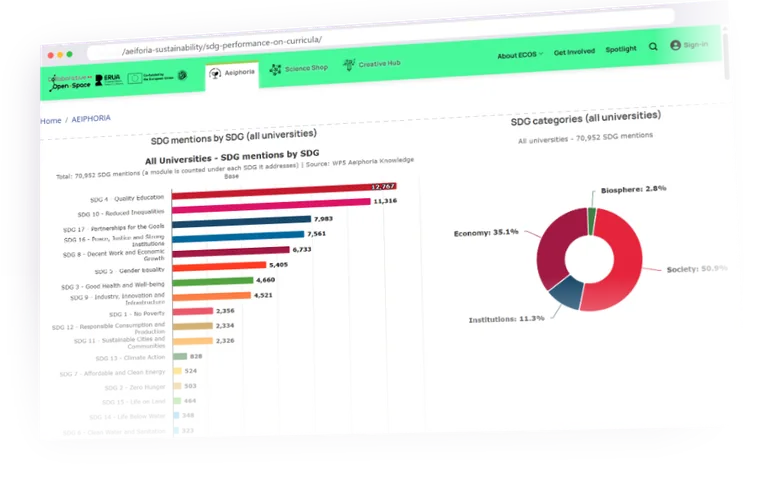
ECOS platform, AEIPHORIA section: regional downloads and resources, and charts of SDG mentions across the ERUA universities

ECOS · AEIPHORIA

AEIPHORIA at a glance

AEIPHORIA, part of ECOS, links university knowledge to regional impact. It combines regional needs (Eurostat indicators), regional innovation capacity (Regional Innovation Scoreboard) and ERUA’s academic and research expertise mapped against the Sustainable Development Goals.

70,952 SDG mentions mapped in the curricula of the eight ERUA universities

Using AEIPHORIA is optional. To explore it, request access credentials at erua-challenge2impact[-at-]aegean.gr. Attachment 2 – ECOS and AEIPHORIA

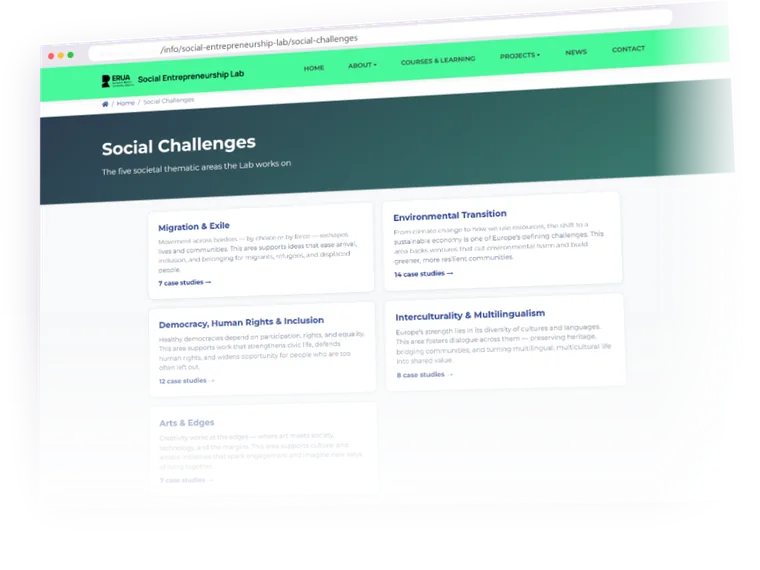
ERUA Social Entrepreneurship Lab, Social Challenges page: the five thematic areas with their case studies

ECOS · Social Entrepreneurship Lab

The five areas, in practice

The ERUA Social Entrepreneurship Lab works around the same five thematic areas as the iDeaThon. Each area page gathers case studies of social enterprises and initiatives from across the alliance.

200+ stakeholder interviews behind the five thematic areas

Explore the Social Challenges

FAQ

Frequently asked questions

Undergraduate, Master’s and PhD students of the eight ERUA universities, academic and research staff of these universities, and regional stakeholders from the ERUA regions. Staff and external stakeholders take part in teams that include at least one ERUA student.

Yes — ERUA students may apply individually or as team leaders.

Up to five members. Each team names one representative, who submits the application and is the organisers’ contact person.

No. A fully developed solution, prototype or business plan is not required at this stage. What matters is a clear concept, its expected benefits for society and a credible path for further development. You may bring an existing idea or develop a new one.

Up to two, individually or as a team member. Each application addresses one thematic area and one specific challenge.

Applicants from ERUA universities must apply with their university email address; applications from other addresses may be rejected unless there is a valid reason. External stakeholders should use their organisation’s or personal email address.

Online capacity-building session 1 on 2 November 2026 is for all applicants. Session 2 on 27 November is for the finalists.

No. All three attachments are optional supporting material; using them is encouraged but not required. To explore AEIPHORIA, request access credentials at erua-challenge2impact[-at-]aegean.gr.

No. The €5,000 / €3,000 / €1,000 awards, funded by ULPGC, cover eligible expenses directly related to the winning idea — such as training, conferences, consultancy, prototyping or communication — approved in advance by ULPGC.

You keep the rights to your idea. The organisers may use your short bio and a description of your idea to promote the competition, will always credit you as the author and will ask your permission before changing any texts or videos. A non-disclosure agreement (NDA) will be provided to protect participants’ intellectual property.

In line with the GDPR (Regulation (EU) 2016/679). The University of the Aegean manages the data in cooperation with the ERUA partners; data are kept for one year after the results of the ERUA Hackathon 2027 are published, and then deleted. To exercise your rights or ask about data processing, email erua-challenge2impact[-at-]aegean.gr.

The organising team at erua-challenge2impact[-at-]aegean.gr.

No — participation is free of charge.