⚠ Erasmus Mundus Joint Master — ERUA Alliance

PATHS Forced Migration: Europe in a Global Context

Empowering future leaders to navigate the geopolitical, humanitarian, and socio-economic complexities of displacement in an interconnected world

Duration 4 Semesters
Credits 120 ECTS
Language English
Partners 6 Universities
EU Flag ⚠ Co-funded by the European Union
Quality Assured European
Quality Assurance

About the Programme

The joint Master's programme — PATHS Forced Migration: Europe in a Global Context — focuses on the urgent and complex challenges of forced migration, acknowledging the increasing global displacement driven by geopolitical instability, environmental concerns, and socio-economic factors. The programme aims to prepare professionals with the essential knowledge and skills to understand and effectively tackle these multifaceted issues.

PATHS provides a unique blend of interdisciplinary and intercultural perspectives within a cohesive curriculum. It incorporates mobility pathways, research opportunities, and close collaboration with local, national and international organisations, enhancing students' competencies and adaptability.

PATHS Forced Migration: Europe in a Global Context is a joint Master's degree programme offered by selected member universities of the European Reform University Alliance (ERUA). Throughout your studies, in addition to the core modules of your chosen path, you will have the opportunity to expand your learning with extracurricular courses offered by ERUA mobility partners.

Explore the Three Paths

International Mobility

Study in several European countries and experience different academic traditions.

Joint Degree

A flagship initiative in the European Higher Education Area.

Theory and Practice

Obtain a comprehensive theoretical foundation in migration studies coupled with practical experience gained during an internship.

Career Readiness

Graduate with applicable and transferrable skills and a professional network across Europe.

Review needed: The DRAFT text document does not include a dedicated “Key Facts” section. Duration and Language align with the DRAFT. Credits (120 ECTS) and Partners count (6) are from the Student Handbook (DRAFT shows “?” and “5 universities”). Stats Start: 2026/2027, Coordinator: SWPS University, and Mobility: Study at 3 Universities are not present in either document.

Key Facts

⚠ “Everything you need to know at a glance.” — not from DRAFT

Duration
4 Semesters
ECTS Credits
120 ECTS
Language
English (B2+)
Mobility
Study at 3 Universities
Disciplines
Sociology, Political Science & Public Administration, Law & Psychology
Tuition
€9,000 per year

What will you learn?

This interdisciplinary programme, grounded in sociology and enriched by insights from political science, legal science and psychology, offers a comprehensive understanding of migratory phenomena.

Beyond a solid theoretical foundation, we ensure that our graduates gain extensive practical experience. During the programme, you will:

  • Master qualitative and quantitative research methods
  • Participate in intensive field training through specialised internships
  • Gain professional experience within public institutions and intergovernmental organisations (IGOs)
  • Engage directly with individuals who have been forced to migrate
  • Network with global experts specialising in diverse aspects of migration, from children's rights to border control

As a result, you will be well-prepared for academic pursuits, societal challenges, and the demands of the labour market.

Internships

A key element of the programme is its focus on practical experience. During the second semester, alongside mandatory joint courses, you will complete an internship at an organisation of your choice to apply your learning in a professional setting.

Three Study Paths

We offer three study paths, each focusing on a different aspect of migration. Your selected path determines the international university rotation you will follow.

Each path has a dedicated entry university (Semester 1) and specialisation host (Semester 3). All paths converge at SWPS Warsaw in Semester 2 for joint research methods training.

EU Border Regimes

Examine how global inequalities as well as ecological and geopolitical instability shape forced migration. Gain a deep understanding of the legal, technological, and social dimensions of European border regimes. Analyse interactions between migration policies as well as global and racialised inequalities. Develop the critical skills needed to design ethical, socially just, and evidence-based solutions.

Entry S1: Europa-Universität Viadrina
S3: University of the Aegean

Inclusion of Children and Minors

Explore the multifaceted experiences of young people in forced displacement through the lenses of law, psychology, and sociology. Analyse how age, gender, and race intersect within European migration regimes and border experiences. Develop expertise in children's rights, intercultural communication, and trauma-informed care to design inclusive, ethical, and evidence-based reception systems.

Entry S1: Université Paris 8
S3: Università di Macerata

Politics and Policies

Analyse the politics of forced migration and displacement. Trace how securitarian, humanitarian, rights-based, economic, and cultural frameworks shape public narratives. Examine how these narratives influence policy-making and how interest groups use these frames to advance or block reforms. Map key actors, conduct rigorous analysis, and develop skills to craft evidence-based, rights-respecting policy options.

Entry S1: New Bulgarian University
S3: Università di Macerata

Please note: The Admissions Committee reserves the right to offer you a study path different from your initial selection.

Your Study Journey

Four semesters across European universities — from foundations to thesis.

S1
Semester 1
Foundations & Path Entry

Begin at your path’s entry university. Joint online foundations plus path-specific courses.

EUV • Paris 8 • NBU
S2
Semester 2
Research Methods & Internship

All cohorts converge at SWPS Warsaw for the research methods block and professional internship (15 ECTS).

SWPS Warsaw
S3
Semester 3
Path Specialisation

Move to your path’s specialisation university for advanced courses and the joint Research Colloquium.

UAegean • Macerata
S4
Semester 4
Master’s Thesis

Co-supervised thesis (30 ECTS) by academics from at least two partner universities.

Joint supervision
Review needed: The Curriculum section has no equivalent in the DRAFT text document. Content was written independently and must be reviewed before publishing.

Curriculum

120 ECTS across four semesters. Joint online foundations, path-specific courses, research methods training, internship, and a co-supervised thesis.

EU Border Regimes Europa-Universität Viadrina → SWPS → University of the Aegean
Inclusion of Children & Minors Université Paris 8 → SWPS → Università di Macerata
Politics & Policies New Bulgarian University → SWPS → Università di Macerata

All paths share Semester 2 (SWPS Warsaw) and Semester 4 (co-supervised thesis) structure.
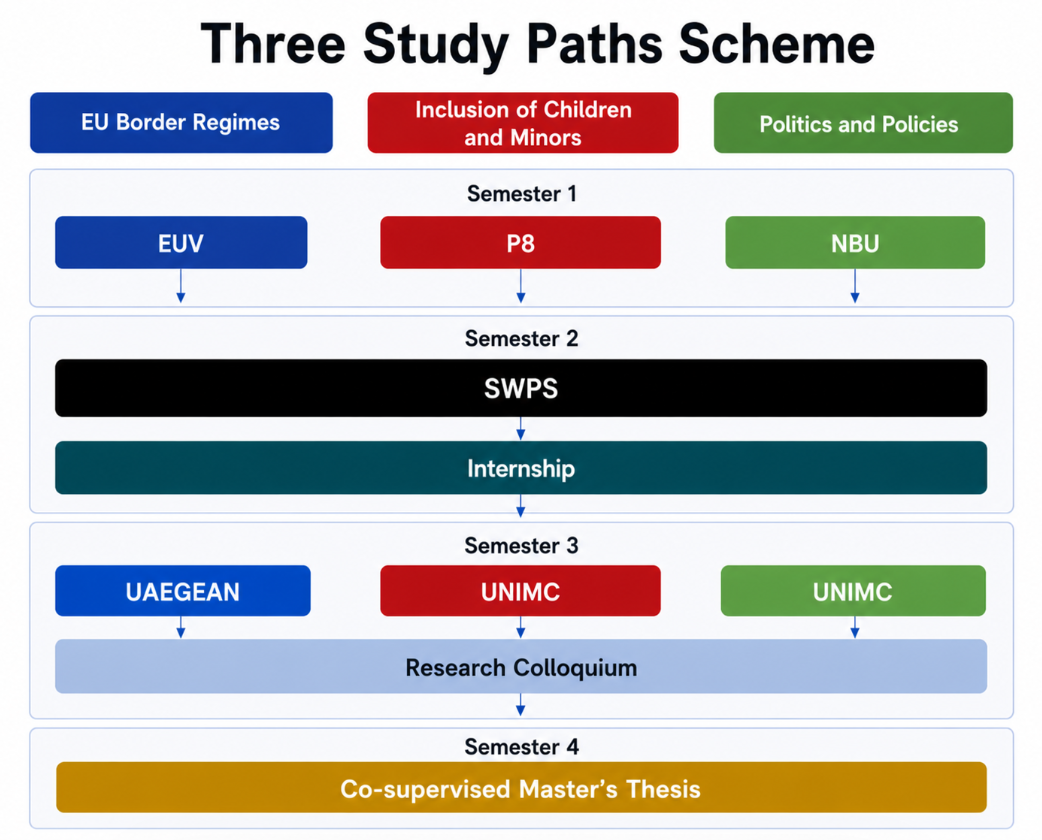
PATHS — 4-semester mobility structure across partner universities

The illustration of the study paths is also available in the Student Handbook.

Introduction to Concepts & Theories of Forced Migration [Joint — all paths]
6 ECTS Online / Consortium
The Study of Forced Migration — Empirical Focus [Joint — all paths]
6 ECTS Online / Consortium
European Border Regimes [Border Regimes path — Viadrina]
6 ECTS EUV
Forced Migration & Global Inequalities [Border Regimes path — Viadrina]
6 ECTS EUV
Externalization of European Borders [Border Regimes path — Viadrina]
6 ECTS EUV
Being Young at the Borders [Children & Minors path — Paris 8]
6 ECTS UP8
Introduction Course 2: Age, Gender & Race in European Migration Regimes [Children & Minors path — Paris 8]
3 ECTS UP8
Childhood in Exile: Between Grief, Trauma, and Identity Reinvention [Children & Minors path — Paris 8]
6 ECTS UP8
Approaches to the Reception and Care of Minors [Children & Minors path — Paris 8]
6 ECTS UP8
Migration Policy [Politics & Policies path — NBU]
6 ECTS NBU
Migration Politics [Politics & Policies path — NBU]
6 ECTS NBU
Migration and Civil Society [Politics & Policies path — NBU]
6 ECTS NBU

Introduction to Social Research Methodology
3 ECTS SWPS
Quantitative Research Methods
3 ECTS SWPS
Qualitative Research Methods
3 ECTS SWPS
Research in Multicultural Settings
3 ECTS SWPS
Desk Research
3 ECTS SWPS
Internship
15 ECTS Partner organisation

Research Colloquium [Joint — all paths, online]
6 ECTS Online / Consortium
From the Entry Points to the Social Terms of Coexistence [Border Regimes — UAegean]
6 ECTS UAEGEAN
Civil Society at the Borders: Solidarity & Xenophobia [Border Regimes — UAegean]
6 ECTS UAEGEAN
Reception & Non-Refoulement at Borders [Border Regimes — UAegean]
6 ECTS UAEGEAN
Risks in Migration: Crossing Borders & Digitalisation [Border Regimes]
6 ECTS UAEGEAN
Child Migration and Social Psychology: Prejudice, Inclusion, and Identity [Children & Minors — Macerata]
6 ECTS UNIMC
Children's Rights in Comparative Law [Children & Minors — Macerata]
8 ECTS UNIMC
Development Economics — Inequality [Children & Minors — Macerata]
4 ECTS UNIMC
Migration Law [Politics & Policies — Macerata]
6 ECTS UNIMC
European Union Law [Politics & Policies — Macerata]
8 ECTS UNIMC
Intercultural Communication [Children & Minors — Macerata]
6 ECTS UNIMC
Public Speaking & Leadership Development [Politics & Policies — Macerata]
6 ECTS UNIMC
Development Economics — Inequality [Politics & Policies — Macerata]
4 ECTS UNIMC

Master's Thesis
30 ECTS Joint supervision (2 partners)
Review needed: The Partner Universities & Map section has no equivalent in the DRAFT text document. Content was written independently and must be reviewed before publishing.

Partner Universities & Locations

Study across Europe at leading universities. Each semester takes you to a different city, giving you a truly international academic and cultural experience.
Université Paris 8 Vincennes-Saint-Denis

Paris (Saint-Denis), France

Learn More

University of the Aegean

Mytilene, Lesvos, Greece

Learn More

New Bulgarian University

Sofia, Bulgaria

Learn More

SWPS University

Warsaw, Poland

Learn More

University of Macerata

Macerata, Italy

Learn More

Europa-Universität Viadrina

Frankfurt (Oder), Germany

Learn More

Career Prospects

As a graduate of the PATHS Forced Migration: Europe in a Global Context joint Master's programme, you will possess the theoretical depth and practical expertise in migration governance, border systems, and policy-making required to work in complex migration contexts worldwide, including areas such as:

  • Migration management and border policy agencies at national and European levels
  • International organisations and NGOs working with refugees and displaced persons
  • Diplomatic and intergovernmental relations
  • Public administration
  • Humanitarian and development organisations
  • Social services and community integration
  • Policy advising and governmental institutions
  • Legal advocacy and refugee rights
  • Research institutions and think tanks focusing on migration and border studies
  • Socio-economic development and research
  • Education, training, and intercultural mediation
  • Media, advocacy, and public information on migration issues and refugee rights

Application Step by Step

The admissions process for the PATHS programme is coordinated by SWPS University as the lead institution. Clicking Apply will redirect you to the SWPS University Application Portal.

Student Handbook (PDF)
1
Submit Application

Fill in the online application form and select your preferred study path. Upload all required documents before the deadline. Applications are submitted via the SWPS portal: rekrutacja.swps.pl

2
Await Evaluation Decision

Wait for the decision of the Selection Committee.

3
Take an Exam

To be admitted to the programme, all candidates must pass an entry exam. Some candidates may be invited for an online interview.

4
Conclude Electronic Agreement

Conclude the electronic agreement on the payment terms for studies in the Application Portal.

5
Deliver Original Documents

Deliver (by post, courier, or in person) the original documents to the Admissions Office for verification.

6
Pay Tuition Fee

7
Download Admission Decision

Download your admission decision from the Application Portal.

Admission Requirements

As of 1 July 2025, new Polish government regulations govern applications from non-Polish nationals. Requirements vary based on your citizenship and the country where your degree was issued.

All international applicants must provide:

  • Bachelor’s degree diploma with grade transcript (translated into Polish, English, Russian, or Ukrainian if in another language)
  • Language proficiency certificate (minimum CEFR B2 in English)
  • Medical insurance policy valid in Poland, or declaration of enrolment in Poland’s National Health Fund
  • Official passport photo meeting SWPS specifications
  • Application fee: PLN 85 (non-refundable, except if programme is cancelled)

May be required depending on your citizenship and diploma origin:

  • NAWA diploma recognition — required if your degree was issued outside the EU, OECD, China, Ukraine, or UK
  • Student visa — required for citizens of countries outside EU/EFTA/UK
Full requirements by candidate category — SWPS University

  • Bachelor's degree in social sciences or humanities. Degrees in other fields may also be considered, provided the applicant demonstrates relevant work experience in the field of migration. The recognition of alternative academic backgrounds will be assessed by the Admissions Committee on a case-by-case basis.
  • CEFR B2, or higher, English language proficiency certificate. Review the list of acceptable certificates.
  • Curriculum Vitae (CV)
  • Letter(s) of recommendation from academic or professional referees (max. 2)
  • Cover letter, including a reflective explanation of the applicant's motivation for selecting the specific study path within the programme
  • Certificates or documented evidence of extracurricular activities, such as voluntary work, internships, community engagement, or related initiatives

Application Deadline

31 July 2026
Per Student Handbook — 2026/2027:
Applications open: 1 June
Applications close: 31 July
Entry exam: 12 August
Results published: 13 August
Interviews (if applicable): 17–31 August
Per SWPS programme page:
Application fee: PLN 85.00 (non-refundable, except if programme is cancelled)
Study mode: Full-time, Monday–Friday classes
Register Your Interest
Upcoming Webinar — per SWPS programme page: 30 June 2026 — “Admissions to SWPS University” (free, online). Register via the SWPS application portal: rekrutacja.swps.pl
Review needed: The Testimonials section has no equivalent in the DRAFT text document. Content was written independently and must be reviewed before publishing.
Source: Biograms for PATHS (2026-06) — 25 faculty members from all six consortium universities. ULPGC is an associated partner co-teaching University Paris 8 classes and is listed for completeness.

Faculty

Academic staff from UniMC, University of the Aegean, Europa-Universität Viadrina, Université Paris 8, New Bulgarian University, and SWPS University.

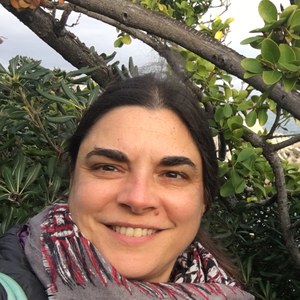
Ildiko Otova
Programme Coordinator
Ildiko Otova
New Bulgarian University
PhD in political science, specialising in migration governance. PATHS Programme Coordinator and European academic coordinator for the EMJM.
Read bio ›
Kira Kosnick
Kira Kosnick
Europa-Universität Viadrina
Professor of Comparative Cultural and Social Anthropology and director of the university's interdisciplinary migration research centre.
Read bio ›
Mouna Maaroufi
Mouna Maaroufi
Europa-Universität Viadrina
Post-doctoral researcher and lecturer in Comparative Cultural and Social Anthropology. Research focuses on transnational feminism and Islamic practices in migration contexts.
Read bio ›
Marija Grujić
Marija Grujić
Europa-Universität Viadrina
DFG Walter Benjamin Fellow. Research focuses on forced migration, asylum governance, gender, sexuality, and violence.
Read bio ›
Ilaria Pirone
Ilaria Pirone
Université Paris 8
Full Professor of Educational Sciences and clinical psychologist. Research focuses on childhood and adolescence in post-colonial urban contexts.
Read bio ›
Jane Freedman
Jane Freedman
Université Paris 8
Professor of Sociology specialising in forced migration and gender, using an intersectional approach. Currently Principal Investigator on an ERC Advanced Grant "Growing Up Across Borders".
Read bio ›
Jean-Christophe Coffin
Université Paris 8
Associate professor of history of child psychiatry and adjunct director of the Institute for the History of Present Times (CNRS).
Read bio ›
Samuel Boussion
Samuel Boussion
Université Paris 8
Associate professor of history of education and child studies, affiliated with the Institute for the History of Present Times (CNRS).
Read bio ›
Antoine Burgard
Antoine Burgard
Université Paris 8
Senior lecturer in contemporary history of humanitarianism at the University of Manchester. Leads an ESRC New Investigator project on age determination in British and French border policing.
Read bio ›
Antoine Rivière
Antoine Rivière
Université Paris 8
Associate professor of history of education and childhood at Paris 8. Research focuses on abandoned children, youth protection policies, and family-less children during 20th-century wars.
Read bio ›
Evelina Staykova
Evelina Staykova
New Bulgarian University
Associate Professor and General Secretary of CERMES, specialising in urban politics, migration, and populism.
Read bio ›
Vanina Ninova
Vanina Ninova
New Bulgarian University
Political scientist and lecturer with expertise in migration studies, refugee integration, and European studies.
Read bio ›
Paula Pustułka
Paula Pustułka
SWPS University
Professor of Sociology carrying out interdisciplinary research on youth, generations, family, and gender in a migration context.
Read bio ›
Agnieszka Golińska
Agnieszka Golińska
SWPS University
PhD in psychology and expert in organisational culture, cross-cultural differences, and competence management.
Read bio ›
Olga Czeranowska
Olga Czeranowska
SWPS University
Sociologist specialising in migration and mobility studies, gender studies, and quantitative research methodology.
Read bio ›
Nikos Nagopoulos
Nikos Nagopoulos
University of the Aegean
Professor and chair of the Department of Sociology, with expertise in migration, vulnerable groups, and socially excluded communities.
Read bio ›
Stratos Georgoulas
Stratos Georgoulas
University of the Aegean
Professor of Sociology and Vice Rector for Internationalisation. Has published over 200 academic works on sociology, migration, and social movements.
Read bio ›
Manos Savvakis
Manos Savvakis
University of the Aegean
Professor of Sociology. Research focuses on sociological theory, micro-sociology, health and illness, and migration. Led the ELIDEK-funded project on long-term refugee settlement in Greece (2020–2022).
Read bio ›
Michalis Poulimas
Michalis Poulimas
University of the Aegean
Assistant Professor in Sociology, teaching on social solidarity, social differences, and immigration.
Read bio ›
Dimitris Paraskevopoulos
University of the Aegean
Assistant Professor in the Department of Sociology. Research analyses social and collective emotions at micro-, meso- and macro-sociological levels, and their intersections with migration and collective identities.
Read bio ›
Christos Kouroutzas
Christos Kouroutzas
University of the Aegean
Associate Professor in the Department of Sociology. Research focuses on Sociology of Risk and Uncertainty, Digital Sociology, and the sociology of Artificial Intelligence and algorithms.
Read bio ›
Nikolaos Xypolytas
Nikolaos Xypolytas
University of the Aegean
Permanent Assistant Professor in Sociology, specialising in migration studies, labour sociology and social policy, with a focus on migrant domestic work, refugee management, and processes of social exclusion.
Read bio ›
Laura Vagni
Laura Vagni
Università di Macerata
Full Professor of Comparative Private Law. Research focuses on European private law, contract law, and property and trust law. Serves as Vice-Rector for Education at Università di Macerata since 2024.
Read bio ›
Rosita Deluigi
Rosita Deluigi
Università di Macerata
Full Professor of General and Social Pedagogy. Research focuses on intercultural dialogue, participatory research, and community development.
Read bio ›
Chiara Aleffi
Chiara Aleffi
Università di Macerata
Professor and researcher in Social Psychology. Research addresses social relations and social inclusion, with a particular focus on vulnerable people.
Read bio ›
Fabio Clementi
Fabio Clementi
Università di Macerata
Professor of Economics. Research centres on the analysis of income and wealth distribution.
Read bio ›
Fabrizio Marongiu Buonaiuti
Università di Macerata
Full Professor of International Law, specialising in private international law, family law, and succession law.
Read bio ›
Edith Cognigni
Edith Cognigni
Università di Macerata
Associate Professor of Educational Linguistics. Research focuses on plurilingual education, intercultural communication, and the linguistic inclusion of migrants in educational and professional contexts.
Read bio ›
Cristina Grieco
Cristina Grieco
Università di Macerata
Tenure-track Assistant Professor of European Union Law, specialising in EU and European Private International Law.
Read bio ›
Manuel Teresi
Manuel Teresi
Università di Macerata
Social psychologist and researcher specialising in social-environmental and occupational well-being.
Read bio ›
Lucas Andrés Pérez Martín
Universidad de Las Palmas de Gran Canaria
PhD in Law, specialising in European family and inheritance law, migration and asylum, and citizens' rights in European integration.
Read bio ›
Nasara Cabrera Abu
Nasara Cabrera Abu
Universidad de Las Palmas de Gran Canaria
Sociologist and Director of Cooperation at ULPGC. Research focuses on migration, diversity, and social policy in the Canary Islands.
Read bio ›
Review needed: The FAQ section has no equivalent in the DRAFT text document. Content was written independently and must be reviewed before publishing.

Frequently Asked Questions

Find answers about the programme structure, path selection, internship, and career paths.

The three thematic paths address distinct dimensions of forced migration: EU Border Regimes examines border governance, externalization policies, and the experiences of people crossing borders; Inclusion of Children and Minors focuses on unaccompanied minors, child protection frameworks, and psychosocial support; Politics and Policies analyses migration governance, policy-making, civil society, and legal frameworks. All three paths share joint foundational modules and converge in semester 2 at SWPS Warsaw.

Path selection is part of the application process. Applicants indicate their preferred path in their cover letter, explaining how it connects to their academic background, professional experience, or research interests. The selection committee takes this into account during admission. Path places are limited, so a strong motivation is important.

Students study at a minimum of two and typically three partner universities: your path entry university in semester 1, SWPS University in Warsaw for semester 2 (all paths converge here), and your path's specialisation university in semester 3. Semester 4 (thesis) may be spent at any partner institution with your supervisory team.

The internship (15 ECTS) takes place in semester 2 alongside the research methods block at SWPS Warsaw. Students select placements from a network of institutional and civil society partners working with forced migrants — including national agencies, international organisations, NGOs, and community groups. Each placement is agreed in advance and supported by academic supervision.

Each student's Master's thesis (30 ECTS) is co-supervised by academics from at least two different partner universities. Supervisors are selected based on the student's research topic and path specialisation. Co-supervision is a core feature of PATHS that ensures genuinely interdisciplinary thesis work and cross-institutional academic mentorship.

Applicants should hold a Bachelor's degree (first-cycle qualification) in a social sciences or humanities field — sociology, political science, law, anthropology, social work, psychology, or similar. Degrees in other disciplines are considered if the applicant demonstrates relevant work experience in the migration field. English proficiency at B2 level (CEFR) or higher is required.

Yes. English is the sole language of instruction across all six partner universities throughout all four semesters. No prior knowledge of Polish, French, German, Italian, Bulgarian, or Greek is required, though some extracurricular cultural activities may involve local languages.

All six partner universities follow the European Approach for Quality Assurance of Joint Programmes. Each institution is accredited by its national QA agency: ACQUIN (Viadrina), NEAA (NBU), PKA (SWPS), ANVUR (Macerata), HCERES (Paris 8), and HAHE (University of the Aegean).

Graduates are prepared for roles across a wide range of sectors, including: migration management and border policy agencies at national and European levels; international organisations and NGOs working with refugees and displaced persons; diplomatic and intergovernmental relations; public administration; humanitarian and development organisations; social services and community integration; policy advising and governmental institutions; legal advocacy and refugee rights; research institutions and think tanks focusing on migration and border studies; socio-economic development and research; education, training, and intercultural mediation; media, advocacy, and public information on migration issues and refugee rights.

Each PATHS partner university offers a range of student support services — including accommodation assistance, language courses, health and counselling support, and more. For a full overview of what each partner university provides, please refer to the PATHS Student Handbook.
Review needed: This CTA Banner section has no equivalent in the DRAFT text document. Content was written independently and must be reviewed before publishing.

Empowering future leaders to navigate the geopolitical, humanitarian, and socio-economic complexities of displacement in an interconnected world

⚠ PATHS is a four-semester, 120 ECTS Erasmus Mundus Joint Master's Degree in Forced Migration, offered by six universities of the European Reform University Alliance (ERUA). Rooted in sociology and enriched by political science, law, and psychology, the programme prepares graduates to address the complex realities of forced migration through three specialisation paths, intensive research methods training, and field placements with institutional and civil society partners.

Register Your Interest

⚠ Contact information to be confirmed — email address not yet available from official sources.