🎯 Chapter Outcome
- A visible, working map of your real stakeholders
- A tool to revisit when things shift (which they will)
- The ability to prioritize who matters most — and how to reach them
“Who really decides whether your project succeeds or fails?”
Most entrepreneurs think of customers and funders — but often forget the silent influencers, the backdoor blockers, and the unexpected champions.
🧠 Define — Who Counts as a Stakeholder?
You don’t need 12 frameworks. You need a sharp lens.
Stakeholders are people or groups who:
- Influence your project
- Are influenced by your project
- Or care about what your project does
Use this Visual Tool: “Concentric Circles of Stakeholders”
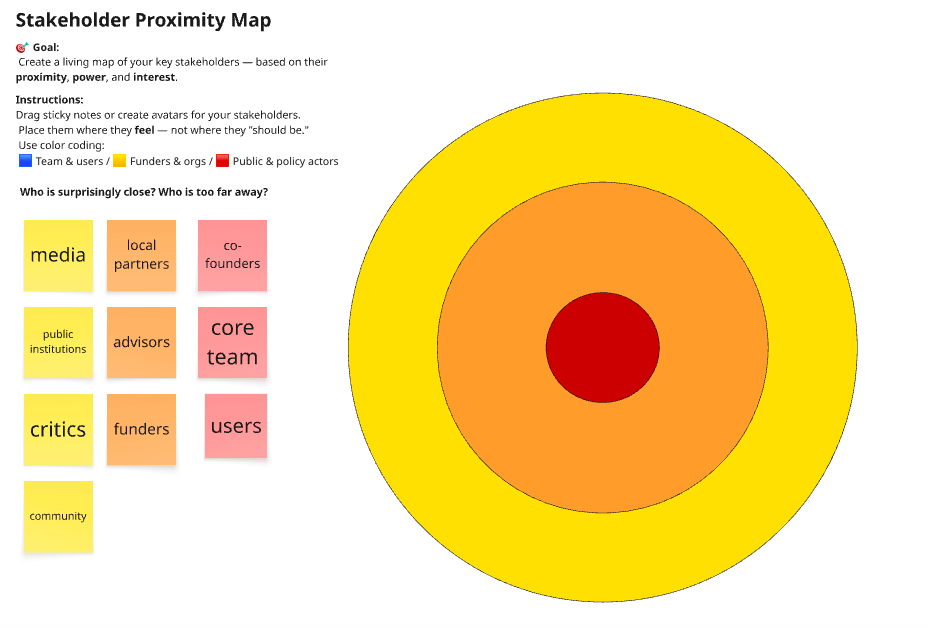
- Core: Internal team, users
- Middle: Funders, partners, public sector
- Outer: Community, critics, regulators
🤱 Quick Activity:
→ Drop 10 names or groups into the circles — no overthinking.
→ Who’s missing? Who has more power than you first assumed?
🤍 You don’t need perfect data. You need a working draft.
🎯 The goal: Make the invisible visible. That’s the power of mapping.
🗺 Stakeholder Mapping for Social Impact Communication
In social innovation, communication isn’t just about power — it’s about trust, values, and shared impact. Use this tool to prioritize and build meaningful relationships.
🔧 Tool: Interest–Influence–Alignment Matrix
Use this matrix to categorize stakeholder groups by their interest, influence, and alignment with your mission/values, then define how to engage with them.
| Stakeholder Group | Interest in Project | Influence on Success / Power | Mission Alignment | Recommended Communication Strategy |
|---|---|---|---|---|
| Users / Beneficiaries | High | Medium | High | Emotional, co-created, participatory |
| Investors / Funders | High | High | Medium–High | Transparent, impact-focused, data-supported |
| Public Sector / Policy Makers | Medium | High | High | Strategic, values-based, SDG-aligned |
| Team / Staff | High | High | High | Inclusive, motivational, shared vision |
| Civil Society / NGOs | Medium–High | Medium | High | Collaborative, peer-based, values-led |
| Media / Public Opinion | Medium | Medium–High | Variable | Storytelling, credible, human-centered |
Engagement Approach — Reframed for Social Impact
- High power + high interest + aligned → Engage, Empower, Co-create
- High power + low interest → Educate and Connect to Mission
- Low power + high alignment → Activate as Advocates
- Low interest + low alignment → Listen, Observe, Learn Respectfully
🧠 Decision prompt for every quadrant:
“If this stakeholder questions my legitimacy or purpose tomorrow, how prepared am I to respond with integrity?”
🧭 Map — Your Real Social Impact Stakeholders
Use this table to reflect on real people and organizations you rely on — or who rely on you. What matters most is not what they can do for you, but what you can build together.
| Stakeholder | Role / Relationship | Power Level | Interest Level | Mission Alignment | What They Care About Most | How I Currently Communicate | How I Should Improve |
|---|---|---|---|---|---|---|---|
| e.g. Local School Board | Gatekeeper to project site | High | Medium | Medium | Reputation, equity, compliance | Occasional newsletter | In-person dialogue, shared goals |
| e.g. Community Center | Grassroots connector | Medium | High | High | Local needs, inclusion, visibility | Ad hoc emails | Community forum, co-designed flyer |
| e.g. Impact Investor | Strategic funder | High | High | Medium | Measurable outcomes, scale | Quarterly reports | Visual impact stories, brief calls |
🔄 Adapt — Strategy Snapshot
🎯 Now create a “first lens” on your communication strategy:
→ Choose 3 stakeholders from different quadrants
→ Define:
- One goal per person (e.g. trust, action, permission)
- One preferred channel (e.g. video update, WhatsApp, meeting)
- One tone/approach (e.g. formal, personal, narrative)
💡 Reflect & Connect
🧠 Reflection Prompt:
“Which stakeholder are you most afraid to approach — and why?”
“What happens if you do nothing?”
💬 Peer Action:
→ Share your map or top insight with your team or other founders in your groups/course
→ Give feedback on one other person’s map (“What are they not seeing?”)