🎯 Outcome of This Chapter
- Build a pitch using a proven structure
- Adapt message, tone, and content to different audiences
- Combine story, data, and clarity for powerful communication
- Feel confident speaking about their work in high-stakes moments
You’ve mapped your stakeholders, understood their logic, refined your messaging, and gathered evidence of your impact. Now it’s time to translate all of it into persuasive, audience-specific pitches that win trust, funding, and collaboration.
“A good pitch is not about sounding smart. It’s about making the right people believe in the right version of your story.”
1️⃣ Engage – When a Pitch Fails
A passionate founder shares how they “pitched their heart out” to investors — and got silence. Why? Because they talked about emotion when the room wanted numbers.
Have you ever misread an audience in a presentation or meeting? What happened?
2️⃣ Understand – The Pitching Core
- Problem – What issue are you solving? Make it real.
- Solution – What are you doing that’s new, bold, or different?
- Impact – What’s the outcome? Mix data + emotion.
AIDA Model:
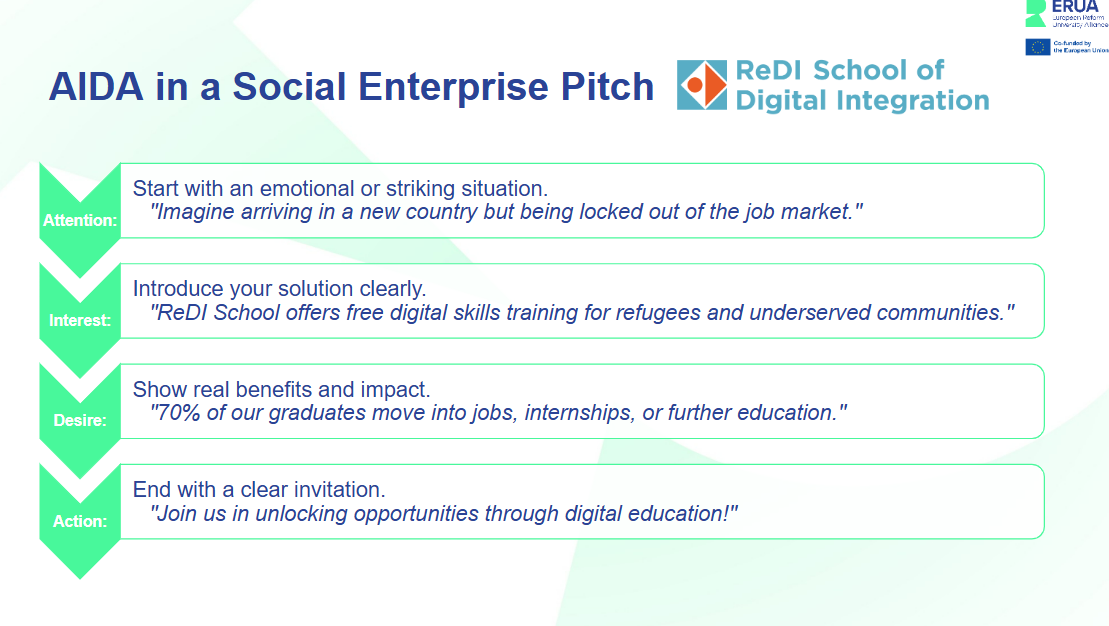
- Attention – Open with something emotional or bold
- Interest – Introduce your mission and method
- Desire – Show your real impact or benefit
- Action – Invite support, funding, partnership
3️⃣ Explore – Pitches by Persona
| Audience | Hook | Focus | Tone |
|---|---|---|---|
| User (Community) | Empathy story | Empowerment, relevance | Motivating, direct |
| Investor | ROI, numbers | Scale + evidence | Strategic, concise |
| Policymaker | Public value + SDG link | Systemic outcomes | Formal, aligned |
Pitch 1: User-oriented (emotional, motivating)
“Imagine arriving in a new country with hopes for a better future — but no way to access the jobs of tomorrow. At ReDI School, we offer free, high-quality digital education to refugees and underserved communities. Our students don’t just learn coding — they build careers, confidence, and connections for a new life.”
Pitch 2: Investor-oriented (data-based, convincing)
“The tech industry needs skilled workers. Refugees and underserved communities need opportunities. ReDI School bridges this gap: with 70% of our graduates moving into internships, jobs, or further education, and an average program cost significantly below traditional pathways. We deliver real integration through digital empowerment — scalable, measurable, impactful.”
Pitch 3: Public policy focused (strategic and impactful)
“Social inclusion and economic growth must go hand in hand. ReDI School’s model equips marginalized groups with future-ready digital skills, directly supporting SDG 4 (Quality Education) and SDG 8 (Decent Work and Economic Growth). Our graduates strengthen communities, fill talent gaps, and drive innovation across Europe.”
Elevator Pitch (under 30 sec)
“ReDI School offers free digital training for refugees and underserved people — unlocking tech careers, boosting integration, and filling Europe’s digital skills gap.”
4️⃣ Apply – Build Your Own Pitch
| Audience Type | Problem Statement | Solution Summary | Outcome (data or story) | Desired Action | Tone + Format |
|---|---|---|---|---|---|
| e.g. Investor | Youth unemployment in rural areas | Free digital training & job mentoring | 70% job placement rate | Funding for pilot scale-up | Strategic, email + pitch call |
- Choose 2 stakeholders from your map
- Draft a tailored 3-minute pitch for each
- Practice delivering at least one out loud (HeyGen, Loom, or with peers)
5️⃣ Deliver – Pitching Practicum (Optional)
- Record a pitch using HeyGen or Loom
- Upload for peer review (or use AI feedback prompt)
Feedback Guide: Is the opening memorable? Does it match the audience logic? Is there a clear CTA (Call to Action)?
6️⃣ Reflect – What Makes You Trust a Pitch?
- What kinds of pitches make you want to support a cause?
- What part of your story are you most afraid to share — and why?
- If you had 90 seconds in front of your dream funder, what would you leave out?
📢 Peer Sharing Prompt: → “Give one strength + one suggestion for a peer’s pitch.”